

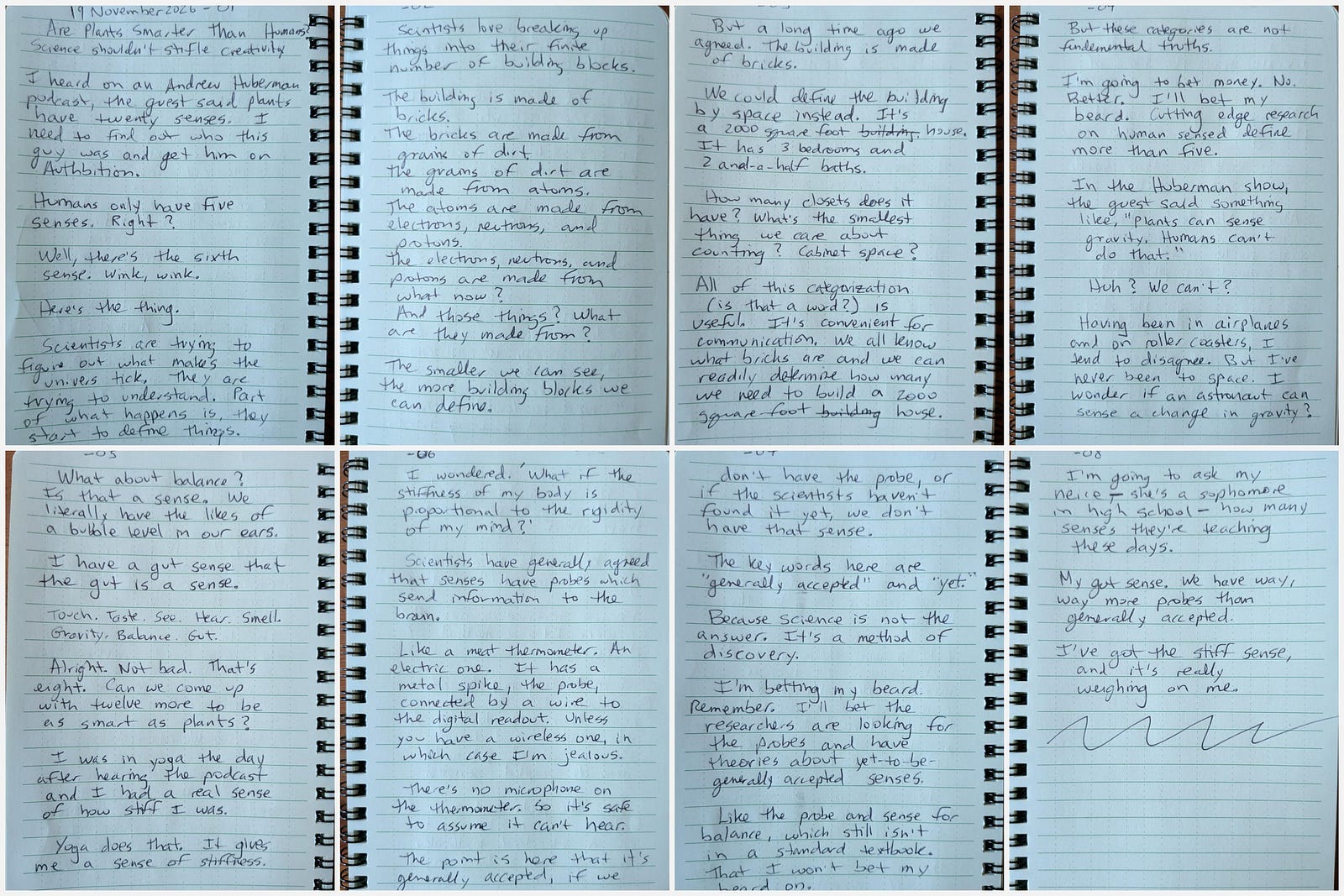
I heard on an Andrew Huberman podcast, the guest said plants have twenty senses. I need to find out who this guy was and get him on Authbition.
Humans only have five senses. Right?
Well, there’s the sixth sense. Wink, wink.
Here’s the thing.
Scientists are trying to figure out what makes the universe tick. They are trying to understand. Part of what happens is, they start to define things.
Scientists love breaking up things into their finite number of building blocks.
The building is made of bricks.
The bricks are made from grains of dirt.
The grains of dirt are made from atoms.
The atoms are made from electrons, neutrons, and protons.
The electrons, neutrons, and protons are made from what now?
And those things? What are they made from?
The smaller we can see, the more building blocks we can define.
But a long time ago we agreed. The building is made of bricks.
We could define the building by space instead. It’s a 2000-square-foot house. It has 3 bedrooms and 2 and-a-half baths.
How many closets does it have? What’s the smallest thing we care about counting? Cabinet space?
All of this categorization (is that a word?) is useful. It’s convenient for communication. We all know what bricks are and we can readily determine how many we need to build a 2000-square-foot house.
But these categories are not fundamental truths.
I’m going to bet money. No. Better. I’ll bet my beard. Cutting edge research on human senses defines more than five.
In the Huberman show, the guest said something like, “plants can sense gravity. Humans can’t do that.”
Huh? We can’t?
Having been in airplanes and on roller coasters, I tend to disagree. But I’ve never been to space. I wonder if an astronaut can sense a change in gravity?
What about balance? Is that a sense? We literally have the likes of a bubble level in our ears.
I have a gut sense that the gut is a sense.
Touch. Taste. See. Hear. Smell.
Gravity. Balance. Gut.
Alright. Not bad. That’s eight. Can we come up with twelve more to be as smart as plants?
I was in yoga the day after hearing the podcast and I had a real sense of how stiff I was.
Yoga does that. It gives me a sense of stiffness.
I wondered. ‘What if the stiffness of my body is proportional to the rigidity of my mind?’
Scientists have generally agreed that senses have probes which send information to the brain.
Like a meat thermometer. An electric one. It has a metal spike, the probe, connected by a wire to the digital readout. Unless you have a wireless one, in which case I’m jealous.
There’s no microphone on the thermometer. So it’s safe to assume it can’t hear.
The point is here, that it’s generally accepted, if we don’t have the probe, or if the scientists haven’t found it yet, we don’t have that sense.
The key words here are “generally accepted” and “yet.”
Because science is not the answer. It’s a method of discovery.
I’m betting my beard. Remember. I’ll bet the researchers are looking for the probes and have theories about yet-to-be generally accepted senses.
Like the probe and sense for balance, which still isn’t in a standard textbook. That I won’t bet my beard on.
I’m going to ask my niece — she’s a sophomore in high school — how many senses they’re teaching these days.
My gut sense. We have way, way more probes than generally accepted.
I’ve got this stiff sense, and it’s really weighing on me.
Author’s note: This is DiMeo Unfiltered where I present work in it’s raw format. The text above is a lightly cleaned up version of what was originally written in the notebook pages without access to a phone or computer.
This is an excerpt from one of my projects. Unlearning The Dogmatization of Science.
Since finishing the piece, I’ve done a little poking around, and, the good news for my wife is, I’ll be keeping the beard.
The podcast guest I was thinking of is Michael Pollan. Here’s a link to the Huberman Lab for his show. It’s an incredible listen.
A quick text to my niece went like this:
“How many senses do humans have? I’m curious what they’re teaching in school these days.”
Her response: “Ummm 5 senses”
I learned that balance was a sense in grad school nearly 30 years ago. Her reply is an indication of just how difficult it is to move the needle when it comes to dogma.
I still need to talk to an astronaut to see if they have a sense of gravity. Good thing. I happen to know one.
Thank you for reading.
Health, happiness, kindness, respect
for every being and all things.
— Andrew

© 2026 Andrew J. DiMeo, Sr., PhD.
All rights reserved. Permission granted to share with attribution.