

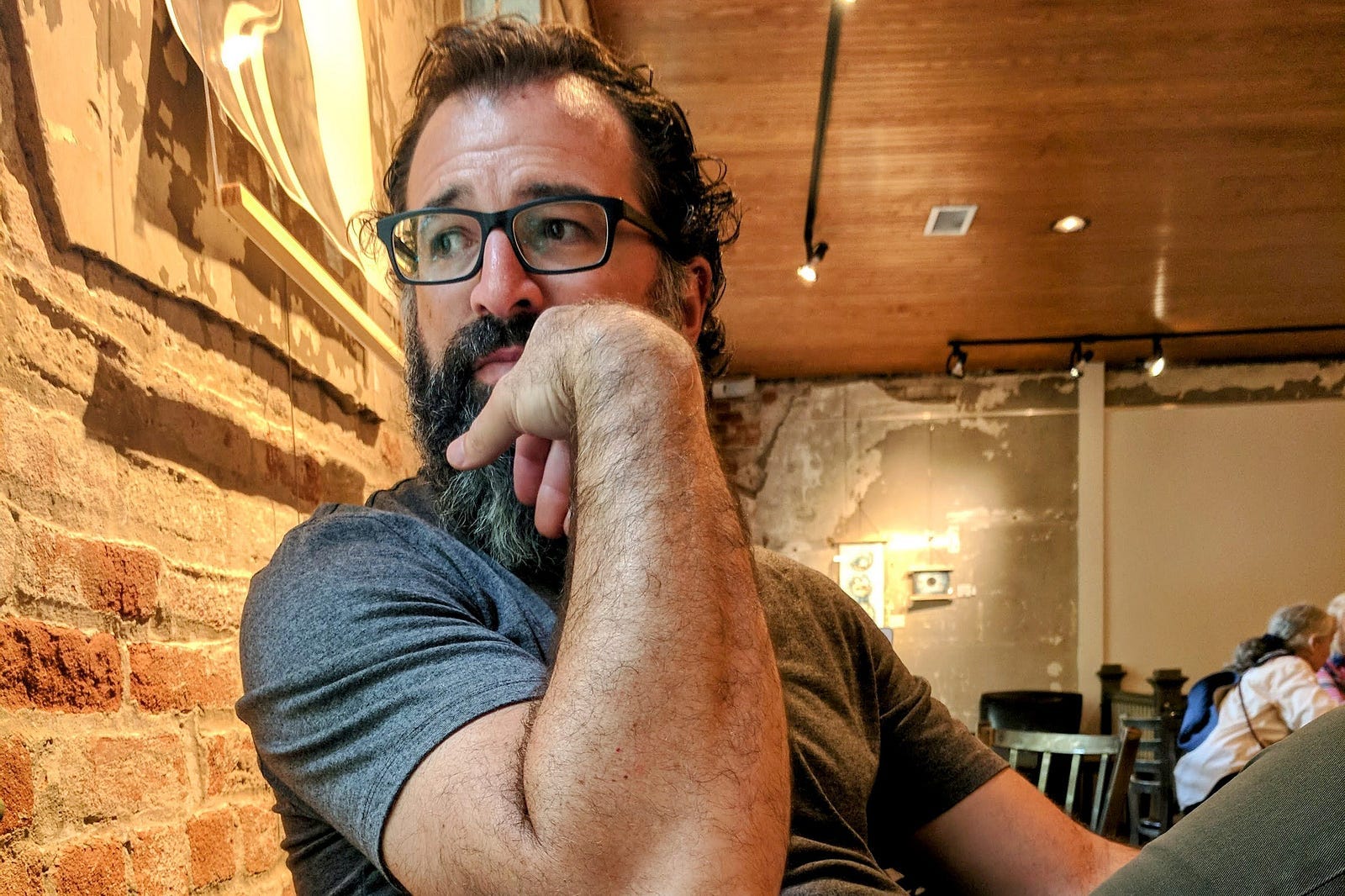
I’m in the process of writing a new essay on sleep. One of the unlocks is is to practice saying, “Dear (thing I hate or fear), I love you.”
In the case of sleep, it’s, “Dear Insomnia, I love you.”
This reminded me of Dear Forgetting, I Love You.
This of my most read essays of all time, originally appearing on Medium in The Narrative Arc, a publication created by Debra Groves Harman. In this story, I go head to head with one of my greatest fears. Forgetting.
Big shoutout to Jojo Teckina who edited this essay. Her feedback helped me discover a subtext in this piece that I didn’t see at first.
“Where are you right now?” Abby said. She is great at reading body language.
“I’m sorry. I was writing. You have my attention now.”
I look intently at her and think, “Okay, Andrew, make eye contact. Stay focused on the eyes. Look at her eyes. Stay locked on the eyes. Uh oh. What did she say?” All I can hear is me reminding myself to look at her eyes. “Shoot! Shut up and listen.”
I’m not a good listener.
In business meetings, it’s essential to focus on the client. I do listen, and it’s intentional, but it’s not easy. I’ve attacked the problem from every angle: remove distractions, turn off the radio, silence the ringtone, put the phone in a separate room, take attentive notes, and make eye contact. These hacks work well in professional settings, especially on Zoom, where I can control the environment.
When I’m relaxed, that’s when the trouble begins. I’m comfortable with loved ones — my wife, especially. I stare into her eyes and think, “Andrew, pay attention, you want to hear this.” But instead of listening, I float into space.
Listening is the tip of the iceberg. My inner dialogue is a self-imposed distraction from the many joys of life. That shooting star? I missed it. The bear in the woods behind the tree with the vibrant red leaves stood out to you. I missed it. I was holding on to some idea. I ruminate and repeat in an infinite loop.
Without a trusted advisor to break me of that cycle, this can get dangerous. Why? One of my greatest strengths is persuasion. When I’m in my own head, I can convince myself to do anything. If I have a potential partner who doesn’t challenge me, I can suck them into a venture destined for failure. This has burned me in business and relationships.
My first serious girlfriend was in high school. I threw the lasso around the moon and pulled her in, just like George Bailey in “It’s a Wonderful Life.” But the life I built was pure fantasy. It was my fiction, without listening to the girl.
We were both so innocent. Eventually, she came to her senses and broke up with me. It shattered my universe — the space I’d invented between my ears.
She opened my eyes to what happens when taking a relationship for granted. I began building an arsenal of tactics to be a better listener. Thirty-four years after graduating from high school, I still work on being attentive and staying present, and I’m doing well at it. But it’s not easy. This is where yoga enters the story.
May I live with ease.
A yoga instructor introduced me to Metta meditation. It’s a loving-kindness mantra that goes like this: May I be safe. May I be happy. May I be healthy. May I live with ease.
It starts with the self and then repeats to loved ones, neighbors, and everyone everywhere: May all people of the world be safe, happy, healthy, and live with ease.
It began naively, as a date, when Abby suggested we go to a yoga class at the YMCA. I kept going back because it made my body feel so good. A decade later, yoga is more about mind than body, and it’s blossomed into meditation, coaching, seeking new knowledge, spiritual wonder, and self-study. I call it all yoga, because it’s the beginning, and it converged my mind and body into one. But that’s another story.
This is about being a better listener.
Yoga taught me that suffering is resistance to the source rather than the source itself. I used to have lower back pain. When getting a massage to work it out, I wondered why the therapist spent so much time on my neck and shoulders instead of where I felt the pain. She was smarter than I. The source of my lower back pain was the stiffness in my upper, previously hunched, back.
But my lower back pain wasn’t from being hunched; it was from the weight I carried on my neck and shoulders. An emotional weight. Letting go of that burden, my back feels better, I stand taller, my sciatica is relieved, and I no longer clench my teeth while sleeping. These once-ailments are now signs. I appreciate them.
So, what happened when I took the practice from the mat and applied it to listening? Rather than resisting distraction, I learned to pay attention with ease. Instead of adding more tactics, I’ve moved to a state of wonder. I am closer to the source.
I wonder why I don’t listen? I’m curious. Why am I always in my head? What am I afraid of?
Wait. What did I just say? “What am I afraid of?
I’m not sure why I was so surprised to get to fear. That’s a natural place to arrive when letting go of resistance. But there I was, wondering what I was afraid of. The answer came in a flood.
I must be afraid of forgetting. I’m holding on to my words because I’m afraid of losing them. Oh, this opened the dam. I’m worried I’ll forget an awesome idea that could become my greatest essay ever. I fear embarrassment. I might say something foolish. Instead of listening to your story, I’m conjuring up my response.
I resist forgetting, and the pain manifests as distraction.
Abby challenged me. “Not listening is one of your greatest strengths. It protects you. I’ve seen people want to pick a fight with you, and it just rolls off like nothing.” She’s right. Lack of attention is a fortress I’ve built to protect myself. Sometimes it’s good to be inside the protective gates. But instead of installing security cameras to see the outside world, when I want to listen, I need to lower the drawbridge. I need to forget with ease.
Listening is vulnerable. Love forgetting.
This didn’t happen overnight. I didn’t immediately become enamored with forgetting. But holding this thought, without judgment, continued to open up a cascade of self-discovery.
I recalled an emotional moment I had with my grandfather. I might have been ten years old when he gave me a chilling warning about the Alzheimer’s he could feel coming. It’s a dark story that I won’t tell today, other than to say, no wonder I’m afraid of forgetting.
But you know what? “Love forgetting” started to sound different over time. It sounded like “anything is possible.” I love “anything is possible.”
Yoga teaches non-attachment. I realized I was partial to my past words instead of being open to the infinite future words. When I stopped fearing forgetting, new ideas started pouring in like drinking water from Niagara Falls, looking up.
I loved forgetting, and creativity exploded. I wasn’t scared to lose my words, and I listened to yours.
The best part? I remembered.
Thank you for reading.
Health, happiness, kindness, respect
for every being and all things.
— Andrew

I get the infinite loop brain from time to time.
I find exercise is a very effective way to break the loop, and avoiding screens.