

I know exactly where I was on September 11, 2001. I know all about the nightmares I’ve had. My Babe Ruth Baseball coach was lost that day. He was a father and a husband. But I’m not compelled to write about any of that today.
Instead, where my mind goes, is to the dichotomy of resilience of humans.
We the people, we tend to celebrate how rapidly we can bounce back from tragedy. Nothing stops our spirit. No world war, terrorist attack, or pandemic can keep us down.
And we should celebrate that.
We are a bright light of hope in the face of whatever darkness the world can throw upon us.
I myself, I celebrate this in my own life.
The darkest things that happen to me, they stop with me. I want nothing more than to be a bright light of hope.
Is what I’m about to write a departure from that? We shall see. The words haven’t yet spilled.
Every pro has a con.
And side note, I’ve used “con” a couple of times recently, and only now am I seeing that it’s two meanings both apply.
What we’re great at is also the con. It’s the gaslight.
Before I dig into the resilience con, I have to pause for my friend Ruben. He’ll be quick to note that we humans are antifragile. This is a concept coined by Nassim Nicholas Taleb in his book by the same name.
Humans are antifragile. That’s different than resilient.
If the label on a fragile box is, “Handle with Care.”Then the label on an antifragile box would be, “Try to break me.”
Throw the box out of the truck. Kick it up the curb. Hurl it onto the front porch. That’d be an antifragile box.
Antifragile means: What doesn’t kill you makes you stronger.
These challenges that we face throughout our lives. When we live through them and learn from them, we come out the other side stronger. We come out the other side more resilient.
So, Ruben, my dear friend. I’ll indulge you. Let’s play with antifragile.
This strength of us humans, to get stronger through challenges. There’s a con. There’s always a con.
My life’s work has been spent in the field of creativity. One of the most powerful tools for creative thinking that I’ve encountered is recognizing and holding a paradox.
To make this actionable, I’ve created a game. It’s called The Whole Mind Game.
To root out the con (the trap) for antifragility, Let’s turn to the game.
Here’s how it works. The incredible designer Stefanie made this awesome set of instructions and game board to play:
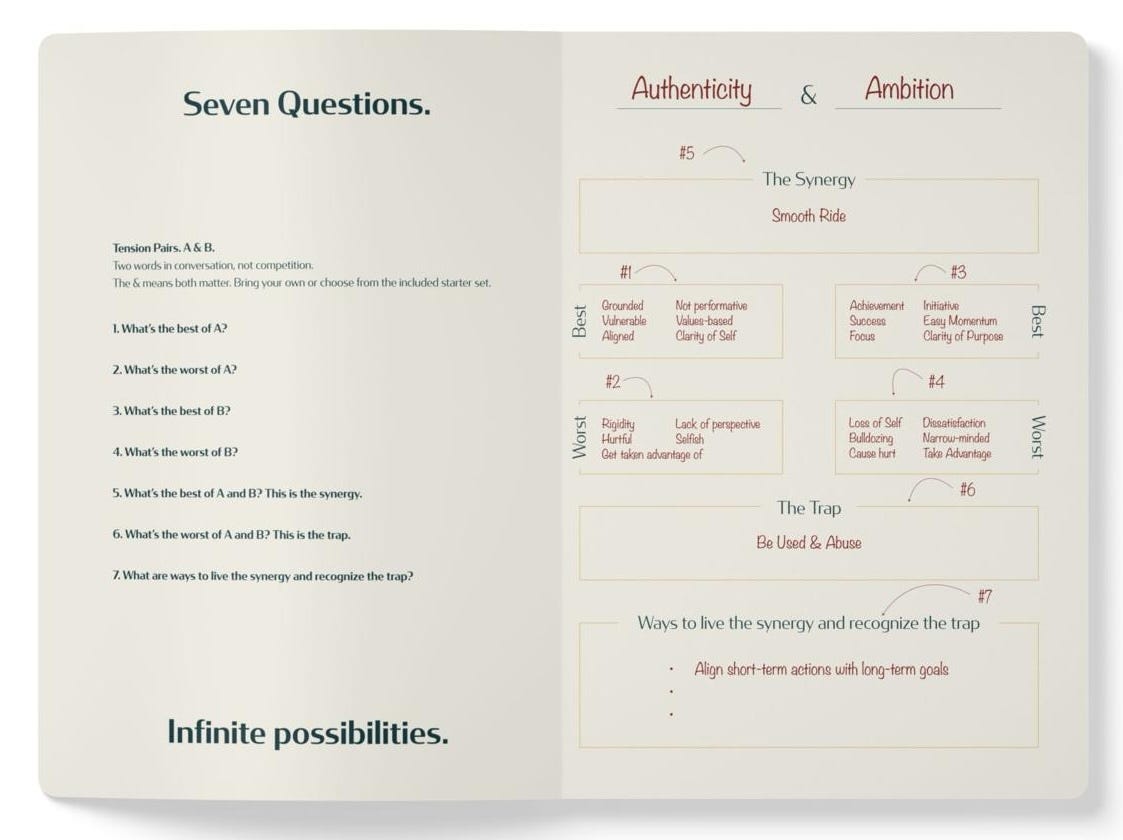
This is a sneak peek to a notebook she’s designing. It’s an example of The Whole Mind Game looking at the pros and cons of authenticity and ambition (the root words that make up Authbition).
I’m going to play now, live as I type, with fragile and antifragile.
There will be no editing. No polishing. What comes next is honest reflection at 6:30 AM from an Airstream parked in Cedar Mountain on the 25th anniversary of 9-11.
What’s the best of fragile?
The thoughts bubbling in my head are about beautiful things. Precious things. Fine china. Pieces of art. Everything that’s ever come delivered in that box labeled, “Handle with Care.”
In the game I go from prose, like above, usually in conversation with another player, to a list of words and short phrases, as seen in Stefanie’s example.
Beautiful. Precious. Cherished. Valuable.
What’s the worst of fragile?
Easily broken. Expensive.
What’s the best of antifragile?
This is the entire opening of this essay:
Strength through adversity. Results in resilience. Growth.
What’s the worst of antifragile?
Ah, that part we’ve been waiting for. Here’s the con. Being antifragile isn’t all good. There’s downsides to everything.
Where my mind was when I started writing this essay was our ability to bounce back may cause us to forget the lessons learned. We who remember 9/11 may recall the sense of unity we felt as a nation. Twenty-five years later, it feels like we’re more divided than ever.
The first world war didn’t prevent the second one.
So many lessons learned from the COVID-19 pandemic. Lost. We saw clear skies, clean rivers, and wild animals rejoicing. We cherished days off and time spent with loved ones. And here we are, six years later, witnessing some of the worst natural disasters of all time while we’re back at work, burning out like never before.
So what’s the worst of antifragile in a few words and short phrases?
Repeating the same mistakes. Meaner, bigger, badder.
Remember me when? Look at me now!
I’m a stronger asshole.
Kinda sounds like how I’d describe Nassim Nicholas Taleb. Hahaha! I don’t know him. I loved the book. But reading his social media. He kinda seems like an asshole.
I digress.
We’re in the middle of a game.
What’s the best of fragile and antifragile?
Here, I like to see all the words and short phrases from both together:
Beautiful. Precious. Cherished. Valuable.
Strength through adversity. Results in resilience. Growth.
From here, I focus on a couple of words from each side.
Beautiful
Growth
Sometimes I’ll make a new phrase inspired by these two words.
Evolve with love
I call this, “The synergy phrase.” It’s the way I want to live.
What’s the worst of fragile and antifragile?
Easily broken. Expensive.
Repeating the same mistakes. Meaner, bigger, badder.
From this group of words, I go through a similar process. I lean in on both sides, and then come up with a short phrase that captures the essence of these words. I call this the trap. It’s the con. It’s what I want to recognize when it’s happening so that I can change my behavior, and move towards the synergy.
Ruthless weakling.
I like to end the game by brainstorming ways to live the synergy and recognize the trap.
What are ways to live evolve with love and recognize ruthless weakling?
While I’m in the depths of my next challenge, write down the lessons learned.
Turn my lessons learned into mantras.
When I feel burnout, pause and reflect.
When I act out ruthlessly, seek the weakling within me.
I didn’t live through any world wars. But I lived through 9-11. I lived through the pandemic. I’ve lived through heartbreak too many times. And I’ve repeated too many mistakes.
Today, on the 25th anniversary of the day the Twin Towers fell, it’s not too late to remember the lessons I’ve learned during the darkest days of my life.
Evolve with love.
Thank you for reading.
Health, happiness, kindness, respect
for every being and all things.
— Andrew

© 2026 Andrew J. DiMeo, Sr., PhD. All rights reserved. Permission granted to share with attribution.
Andrew, my dear friend, consider me thoroughly indulged….and challenged.
One clarification: my argument when we spoke was that we should strive to become antifragile…work toward that capacity.
I don’t believe humans are antifragile by definition, or that suffering automatically makes us stronger.
As I’ve written recently in my own essays, the goal is to become more difficult to overwhelm by training ourselves to withstand adversity. That takes practice, recovery, and sometimes accepting care.
Your game asks a question that “stronger” alone cannot answer: stronger in service of what? Becoming more capable of enduring life while becoming less capable of loving it is a costly bargain, methinks.
“The darkest things that happen to me, they stop with me.” That is a demanding commitment that asks us to notice when the pain we survived starts shaping how we treat someone else.
I appreciate you making room for what deserves to be handled with care, including in ourselves.
I train to develop the strength to remain open to people, even knowing what that can cost.
“Evolve with love” gives that strength a direction. Thank you for bringing me into this, brother.